Which of the Following Parasite Can Be Acquired by Eating Raw Fish?
The next time you eat sashimi, nigiri or other forms of raw fish, you should consider doing a quick bank check for worms, according to a squad of researchers.
A new study led by scientists at the University of Washington constitute "dramatic increases in the abundance of a worm that can exist transmitted to humans who eat raw or undercooked seafood."
"Its 283-fold increase in abundance since the 1970s could have implications for the health of humans and marine mammals, which both tin can inadvertently consume the worm," according to a report on the scientists' work. They looked at a parasitic worm, known as Anisakis or "herring worm."
Their's is the first study to combine the results of previous research to investigate how the global abundance of these worms has changed through time. The findings were published March 19 in the journal Global Change Biological science.
"This study harnesses the power of many studies together to testify a global picture of change over a nearly 4-decade period," said corresponding author Chelsea Woods, an assistant professor in the UW School of Aquatic and Fishery Sciences.
"It's interesting because it shows how risks to both humans and marine mammals are changing over time. That's important to know from a public health standpoint, and for agreement what's going on with marine mammal populations that aren't thriving."
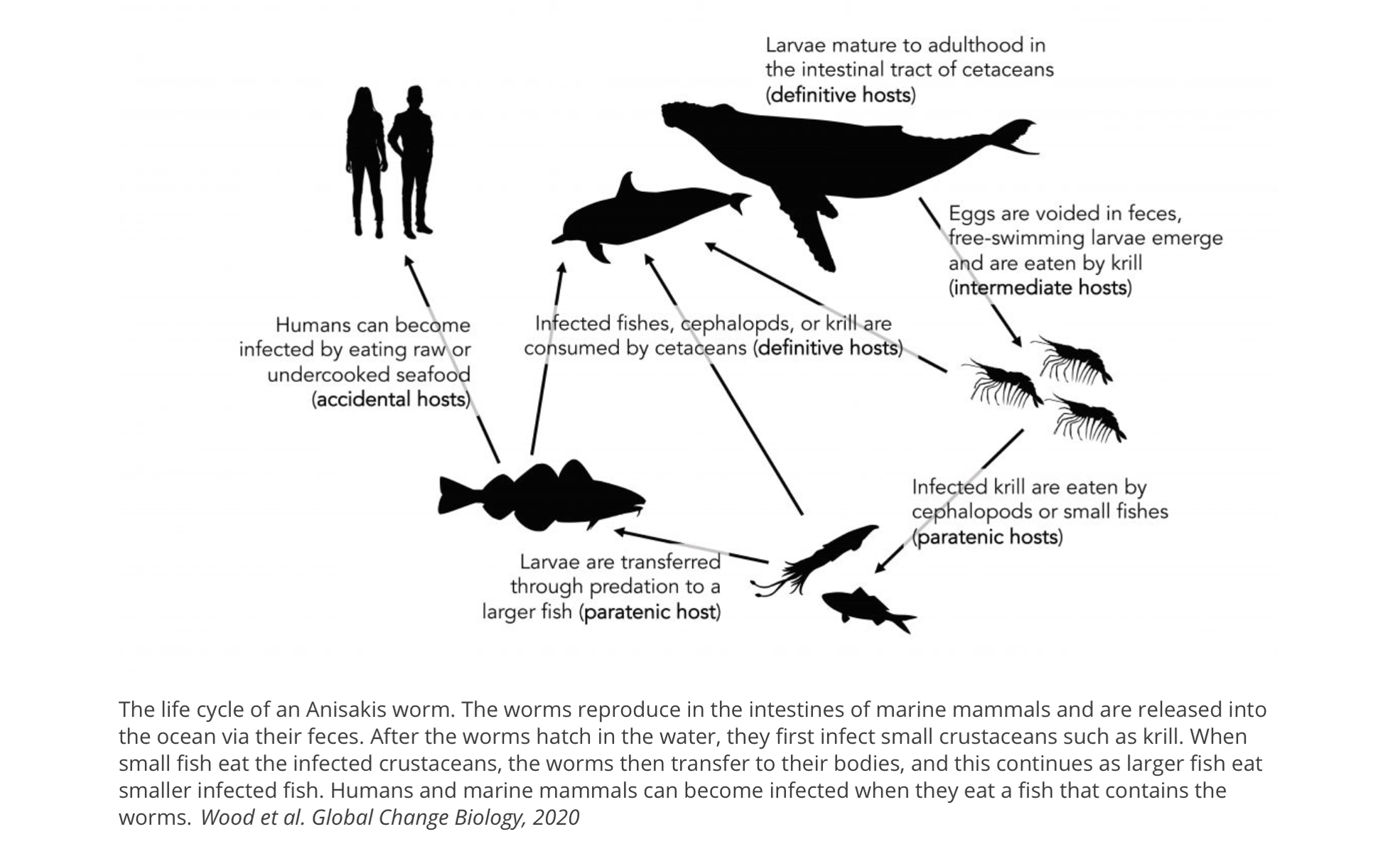
When people swallow alive herring worms, the parasite can invade the abdominal wall and cause symptoms that mimic those of food poisoning, such as nausea, vomiting and diarrhea. In about cases, the worm dies after a few days and the symptoms disappear. This affliction, called anisakiasis or anisakidosis, is rarely diagnosed because nigh people assume they merely suffered a bad case of food poisoning, according to the U.South> Centers for Disease Control and Prevention.
The worms can't reproduce or live for more than than a few days in a homo's intestine, but they can persist and reproduce in marine mammals. The worms actually reproduce in the intestines of these animals and are released into the bounding main via the marine mammals' feces. Then the worms infect other creatures.
The worms tin can be upwards to ii centimeters in length, nigh equally long as a nickel is wide.
The worms actually reproduce in the intestines of these animals and are released into the body of water via the marine mammals' feces, then infecting more animals.
"Ane of the of import implications of this study is that now we know there is this massive, rising wellness risk to marine mammals," Wood said. "It'south not often considered that parasites might be the reason that some marine mammal populations are failing to bounciness dorsum. I hope this study encourages people to await at intestinal parasites as a potential cap on the population growth of endangered and threatened marine mammals."
The authors aren't certain what acquired the large increase of Anisakis worms over the past several decades, but climate change, more nutrients from fertilizers and runoff, and an increase in marine mammal populations over the same period could all be potential reasons, they wrote.
Co-authors are Evan Fiorenza, who completed the work as a UW graduate student; Catrin Wendt, a graduate educatee in the UW Schoolhouse of Aquatic and Fishery Sciences; Katie Dobkowski of Bates College; Teri Male monarch of Washington Sea Grant; Marguerite Pappaioanou and Peter Rabinowitz of the UW School of Public Wellness's Department of Ecology and Occupational Health Sciences; and Jameal Samhouri of NOAA's Northwest Fisheries Science Center.
This report was funded by Washington Sea Grant, the National Science Foundation, the Alfred P. Sloan Foundation and the Academy of Washington.
(To sign up for a costless subscription to Nutrient Safety News, click here .)
Source: https://www.foodsafetynews.com/2020/03/scientists-find-evidence-of-huge-increase-in-parasitic-worms-found-in-raw-seafood-dishes/

Post a Comment for "Which of the Following Parasite Can Be Acquired by Eating Raw Fish?"