How Will Keeping a Personal Journal Bless Me and My Family?

In religion, a approval (also used to refer to bestowing of such) is the infusion of something with holiness, spiritual redemption, or divine will.
Etymology and Germanic paganism [edit]
The modernistic English language linguistic communication term bless likely derives from the 1225 term blessen, which developed from the Old English blǣdsian (preserved in the Northumbrian dialect effectually 950 Advertising).[1] The term as well appears in other forms, such as blēdsian (before 830), blētsian from effectually 725 and blesian from around one thousand, all meaning to brand sacred or holy by a sacrificial custom in the Anglo-Saxon pagan menstruum, originating in Germanic paganism; to mark with blood.[1] Due to this, the term is related to the term blōd, pregnant blood.[1] References to this indigenous practice, Blót, exist in related Icelandic sources.
The modern meaning of the term may accept been influenced in translations of the Bible into Onetime English during the process of Christianization to interpret the Latin term benedīcere meaning to "speak well of", resulting in meanings such as to "praise" or "extol" or to speak of or to wish well.[1]
Abrahamic religions [edit]

'To be blest' means to be favored by God, the source of all blessing.[2] Blessings, therefore, are directly associated with, and are believed to come from, God. Thus, to express a blessing is like bestowing a wish on someone that they experience the favor of God, and to admit God as the source of all blessing.
A biblical damnation, in its nigh formal sense, is a negative blessing.
In the Bible, positive and negative blessings are related; the book of Deuteronomy prescribes that obedience to the Law of Moses brings God'due south blessing. One of the beginning incidences of approving in the Bible is in Genesis, 12:i–2 where Abram is ordered by the God to go out his country and is told:
"I volition anoint yous, I will make your proper noun great."
The Priestly Blessing is set forth at Numbers 6:24–26:
- May Adonai bless you, and guard yous;
- May Adonai make His countenance shine upon you lot, and be gracious to you;
- May Adonai turn His countenance to you and grant you peace.
Judaism [edit]
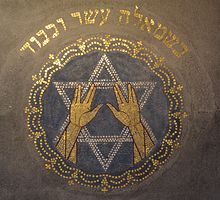
Position in which a Jewish kohen places his hands and fingers during the Priestly Approval, detail of a mozaic in the Synagoge of Enschede, Netherlands[3]
In Rabbinic Judaism, a blessing (or berakhah) is recited at a specified moment during a prayer, anniversary or other activity, especially before and subsequently partaking of food. The function of blessings is to admit God equally the source of all blessing.[two] A berakhah of rabbinic origin typically starts with the words, "Blessed are You lot, Lord our God, King of the universe..." Rabbinic Judaism teaches that nutrient ultimately is a gift of the one great Provider, God, and that to partake of food legitimately ane should express gratitude to God by reciting the appropriate approving of rabbinic origin prior, while torah mandates an breezy approval afterwards.[2] Jewish law does not reserve recitation of blessings to only a specific grade of Jews; but it does mandate specific blessings to specific occasions, so that, for example since medieval times, Jewish women importantly recite a rabbinic blessing later on lighting ii Shabbat candles.
Christianity [edit]

Blessings and curses of Christ appear in the New Attestation, as recounted in the Beatitudes of Luke 6:xx-22. Within Roman Catholicism, Eastern Orthodoxy, Anglicanism, Lutheranism, and similar traditions, formal blessings of the church are performed past bishops, priests, and deacons. Particular formulas may be associated with episcopal blessings and papal blessings. In Roman Catholic, Eastern Orthodox, Anglican, and Lutheran churches blessings are bestowed past bishops and priests in a liturgical context, raising their correct hand and making the sign of the cross with information technology over persons or objects to exist blessed. They besides give blessings to begin divine services and at the dismissal at the end.
In the Eastern Orthodox Church liturgical blessings are performed over people, objects, or are given at specific points during divine services. A priest or bishop normally blesses with his hand, but may use a blessing cantankerous, candles, an icon, the Chalice or Gospel Book to bestow blessings, always making the Sign of the Cross therewith. When approval with the hand, a priest uses his right hand, belongings his fingers and so that they form the Greek messages IC XC, the monogram of Jesus Christ. A bishop does the same, except he uses both hands, or may agree the crozier in his left paw, using both to brand the Sign of the Cantankerous. A bishop may also bless with special candlesticks known as the dikirion and trikirion. When approval an object, the rubrics often instruct Orthodox bishops and priests to make employ of such substances equally incense and holy water. Besides, formal ecclesiastical permission to undertake an action is referred to equally a "blessing". The approval may be bestowed by a bishop or priest, or by 1'southward own spiritual father. When an Orthodox layperson bestows a blessing, he or she volition hold the pollex and first two fingers of the right mitt together (the same configuration used when making the Sign of the Cross on themselves), and brand the sign of the cross over the person or object they are blessing.
In the Methodist tradition, the minister blesses the congregation during the terminal part of the service of worship, known equally the benediction. With regard to house blessings, the Methodist The Book of Worship for Church building and Home (1965) contains "An Part for the Approval of a Dwelling house".[4]
In the Roman Cosmic Church a priest or bishop blesses the faithful with the Blessed Sacrament in the monstrance during Benediction of the Blessed Sacrament. According to the guidelines given by the Vatican's Congregation for the Subject area of the Sacraments that govern the procedures for liturgical ceremonies, if a Roman Catholic layperson (a lay acolyte or parish administrator, for example) or any non-ordained religious (who is non the superior of the congregation) leads a Sunday service (other than a Mass, which requires a priest to celebrate), such as Eucharistic adoration, the Rosary, or celebration of the Liturgy of the Hours, he or she does not perform rites or sacraments reserved to the clergy and does not solemnly bless the people every bit a bishop, priest, or deacon would at the end of the service; an alternative format is used instead.
In the Lutheran Churches, priests are often asked to bless objects ofttimes used past or sacred to individuals, such equally a cross necklace; in improver, Lutheran clergy besides bless the homes of members of the congregations.[v]
In The Church of Jesus Christ of Latter-day Saints, blessings are given by worthy, male members who hold the Melchizedek priesthood.[6]
Islam [edit]
Blessings in Islam accept two aspects, according to major scholars of Islam. Blessings are given by Allah as a trial for flesh. Scholars of Islam believe that having fear of being gradually misled past blessings is an attribute of the pious, and not having fear from such even though one is constantly misbehaving is an aspect of the impious. Blessings tin exist a source of success in the afterlife if one is grateful to Allah for them and the same blessings can exist a source for damnation in afterlife if a person is not constantly grateful to God for them.[7]
Islam has no clerical degree, and therefore no blessings reserved to specific individuals. Muslims will frequently pronounce "peace and blessings be upon him" when mentioning the proper noun of Muhammad or indeed, any of the prophets. Muslims will also greet one some other with a blessing every fourth dimension they meet and depart: السلام عليكم ورحمة الله وبركاته every bit-salāmu alaikum wa rahmatul-lāhi wa barakātuh (meaning "may peace, mercy and blessings of God exist upon you lot").[7]
Dharma religions [edit]
Indian religions, which includes Hinduism and other religions like Buddhism, Jainism, Sikhism, etc. are too called Dharmic religions, all of which are based on the different concept of dharma and karma and typical blessings are based on Adhiṣṭhāna, Añjali Mudrā, Darśana and Mudra, etc.
Hinduism [edit]

In Hinduism Puja is a religious ritual performed past Hindus every bit an offering to diverse deities, distinguished persons, or special guests. It is modeled on the idea of giving a gift or offering to a deity or important person and receiving their approval ("Ashirvād"). During the Puja involves an 'Aarti plate' or 'Aarti lamp' is circulating effectually a deity or person and is more often than not accompanied by the singing of songs in praise of that deity or person (many versions exist). In doing so, the plate or lamp is supposed to acquire the ability of the deity. The priest circulates the plate or lamp to all those present. They cup their down-turned easily over the flame and then raise their palms to their forehead - the purificatory blessing, passed from the deity's prototype to the flame, has at present been passed to the devotee.
During the naivedya ritual, a devotee makes an offering of a material substance such as flowers, fruits, or sweets. The deity then 'enjoys' or tastes a chip of the offering, which is and so temporarily known as bhogya. This now-divinely invested substance is called prasāda, and is received by the devotee to be ingested, worn, etc. It may be the aforementioned cloth that was originally offered, or material offered by others and then re-distributed to other devotees. In many temples, several kinds of prasada (e.m. basics, sweets) are distributed to the devotees.

Hindu priest giving approval.
Darshan is a term meaning "sight" (in the sense of an case of seeing or beholding; from a root dṛś "to see"), vision, bogeyman, or glimpse. Information technology is most ordinarily used for "visions of the divine," e.g., of a god or a very holy person or antiquity. Ane could "receive darshana" of the deity in the temple, or from a great saintly person, such as a great guru. The touching of the feet (pranāma) is a show of respect and it is often an integral part of darshan. Children touch the feet of their family unit elders while people of all ages will curve to affect the feet of a smashing guru, murti (icon) of a Deva (God) (such equally Rama or Krishna).[eight]
In that location is a special link between worshipper and guru during pujas, in which people may touch the guru's feet in respect (Pranāma), or remove the grit from a guru's anxiety before touching their own caput.
Another tradition is "Vāhan pujā" (Hindi) or "Vāgana poojai" (Tamil வாகன பூஜை) 'vehicle blessing'. This is a ritual that is performed when one purchases a new vehicle.[ citation needed ]
Buddhism [edit]

Replica of an image at the Sanchi gate at Chaitya Bhoomi, which shows a devotion scene involving a Buddhist stupa.
In Mangala Sutta, Lord Buddha describes 'blessings' that are wholesome personal pursuits or attainments, identified in a progressive manner from the mundane to the ultimate spiritual goal.
Blessings in Buddhism, certain ceremonies are meant to provide blessings.[9]
Other uses [edit]

Approval is also a term used for marriage in the Unification Church, see: Approving Ceremony of the Unification Church.
Clergy volition normally receive a blessing from their ecclesiastical superiors to begin their ministry building. In the Russian Orthodox Church pious laymen would get to a starets (elder) to receive his or her approval before embarking upon any important work or making a major decision in their life. In the Church of Jesus Christ of Latter-day Saints, a member may receive a special blessing, known as a patriarchal blessing, as guidance.
In the U.S., there are sometimes ritual ceremonies to bless companion animals.[10]
In Hawaii anything new (a new building, a new stretch of road to be opened, a new garden) receives a approving by a Hawaiian practitioner (or Kahuna) in a public ceremony (involving also the unwinding of e.1000. a maile lei).[ citation needed ]
In Spanish, there is a blessing which can be used as a tender good day, especially from a parent: Vaya con Dios ("Become with God"), also Adiós (A Dios, "to God"), similar to the French Adieu.
In the Kyrgyz people'south tradition, the blessing (bata or ak bata, "the right blessing" or "white blessing") might be a good wish to somebody by the oldest person or the person with the best reputation before the travel or launch of some action of the person who seeks such a blessing and moral support. The procedure might exist from the pre-Islamic local nomadic traditions with deep family values. Sometimes, older person(southward) might give a negative blessing (and so called "teskeri bata" - "the opposite approving" or "the black approving").[11]
In commercial interactions, a seller's good words virtually the product, such as "I hope you lot savour information technology," could exist considered to exist blessings.[12]
Encounter also [edit]
- Apostolic Blessing
- Benediction
- Blessing of animals
- Darśana
- List of Jewish Prayers and Blessings
- Priesthood approval
References [edit]
- ^ a b c d Barnhart (1995:73).
- ^ a b c Sefer ha-Chinuch 430
- ^ The mosaic text reads "בשמאלה עשר וכבוד" ("in her left hand riches and honour"), which is a role of Proverbs 3:xvi.
- ^ The Book of Worship for Church building and Home: With Orders of Worship, Services for the Assistants of the Sacraments and Other Aids to Worship Co-ordinate to the Usages of the Methodist Church. Methodist Publishing House. 1964. p. 373. Retrieved 25 March 2017.
- ^ Jackson, Katie (1 March 2017). "What is a business firm approval and should you have one?". Fox News. Retrieved 16 September 2018.
- ^ "xx. Priesthood Ordinances and Blessings". churchofjesuschrist.org. Retrieved 2016-09-xvi .
- ^ a b "Dual Nature of Blessings in Islam". July 11, 2016.
- ^ "Welcome to Siddha Yoga Path in India". world wide web.siddhayoga.org.in. Archived from the original on July 21, 2011.
- ^ Assavavirulhakarn, Prapod (1987). "Approval" (PDF). In Jones, Lindsay (ed.). Encyclopedia of religion. Vol. 2 (2nd ed.). Detroit: Thomson Gale. p. 981. ISBN978-0-02-865997-viii. Archived from the original (PDF) on 2017-03-02.
- ^ Holak, Susan 50. (2008-05-01). "Ritual blessings with companion animals". Periodical of Concern Research. Animal Companions, Consumption Experiences, and the Marketing of Pets: Transcending Boundaries in the Fauna-Human Distinction. 61 (5): 534–541. doi:x.1016/j.jbusres.2007.07.026.
- ^ "Сөз таануу". Азаттык Υналгысы.
- ^ Schindler, Robert One thousand.; Sen, Sandipan Southward.; Wiles, Judy A. (2022-01-02). ""Enjoy!" The Furnishings of Service Blessings on the Customer". Services Marketing Quarterly. 43 (ane): 110–128. doi:ten.1080/15332969.2021.1992561. ISSN 1533-2969.
- Barnhart, Robert K. (1995) The Barnhart Curtailed Dictionary of Etymology Harper Collins ISBN 0-06-270084-7
External links [edit]
 | Look upwardly blessing in Wiktionary, the complimentary dictionary. |
 | Wikiquote has quotations related to: Blessings |
Source: https://en.wikipedia.org/wiki/Blessing

Post a Comment for "How Will Keeping a Personal Journal Bless Me and My Family?"